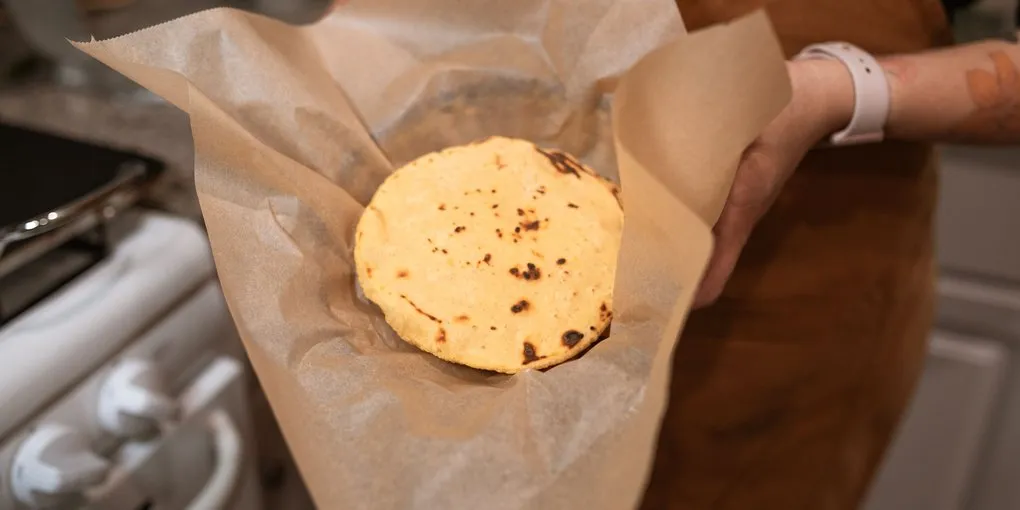
A discard tortilla is a better tortilla. The acid in sourdough discard (pH 3.5-4.5) relaxes the gluten so the dough rolls thin without snapping back, and it slows starch retrogradation so the cooked tortilla stays soft and foldable for 3 days instead of the 12-24 hours you get from a plain flour tortilla. Replace part of the water in a classic lard-and-flour tortilla with discard, ferment briefly, then roll and cook on a dry comal.
A discard tortilla is a better tortilla. That is the thesis — not a tangier tortilla (though it is that), not a sourdough-branded tortilla (though it is also that), but a structurally, chemically better tortilla. The acid in sourdough discard does two things in a tortilla dough that you cannot replicate with vinegar, lemon juice, or any other home-kitchen acidifier: it relaxes the gluten network enough that the dough rolls thin without snapping back, and it lowers the pH enough that the cooked tortilla stays soft and pliable for three to four days instead of the twelve to twenty-four hours you get from a plain flour tortilla.
This recipe takes the classic Northern Mexican flour tortilla — lard, all-purpose flour, salt, warm water — and replaces a portion of the water with sourdough discard. The result ferments briefly on the counter to deepen flavor, rolls dramatically easier than a plain dough, and produces a tortilla that tastes like a Sonoran home kitchen with an extra dimension of complexity layered on top.
If you maintain a sourdough starter, you already have the main ingredient sitting in your fridge. This is one of the highest-return discard recipes in the repertoire: eight tortillas take 90 minutes start to finish, use 200 grams of discard, and produce a bread that is better than any store-bought flour tortilla by every measurable standard.
Why Discard Works So Well Here
Sourdough discard is mature starter at 100% hydration that has been fermented long enough to accumulate acid. Refrigerated discard typically sits between pH 3.5 and 4.5. For comparison, buttermilk is pH 4.5 and lemon juice is pH 2.0. That acid load does three specific things to a tortilla dough:
- Gluten relaxation. Acid accelerates the activity of proteolytic enzymes in the flour, which chew through peptide bonds over time. The net effect is a softer, more extensible dough that rolls thin without fighting back.
- Pliability preservation. Bread staling is partially starch retrogradation as water migrates out of the crumb. Acid slows retrogradation significantly. A tortilla made with discard at pH 4.0 stays soft on day 3 the way a plain tortilla stays soft on day 1.
- Maillard amplification. Fermentation breaks some flour protein down to free amino acids, which are substrates for the Maillard reaction on the hot comal. A discard tortilla develops darker char spots and deeper flavor complexity than a plain tortilla.
The tang is the most obvious payoff, but the pliability and rolling ease are the load-bearing features.
Cultural Context
Sourdough tortillas are not a traditional Mexican category. Traditional Northern Mexican flour tortillas — the ones made in Sonora, Chihuahua, and Nuevo Leon for the last three hundred years — rely on lard and hot water rather than on any starter culture. The discard tortilla is a modern Western home-baker adaptation, born in sourdough communities during the pandemic baking boom when every starter-keeper needed practical ways to use the weekly discard. Because the acid genuinely improves the dough, the adaptation stuck. For a strict traditional flour tortilla recipe without discard, see our companion homemade flour tortillas with lard.
Ingredients
Recipe yields 8 tortillas, approximately 8 inches each.
| Ingredient | Grams | US Measure | Baker’s % |
|---|---|---|---|
| All-purpose flour | 400 g | about 3 1/4 cups | 100% |
| Fine sea salt | 8 g | 1 1/2 tsp | 2% |
| Sourdough discard (100% hydration) | 200 g | about 3/4 cup | 50% |
| Rendered lard, room temperature | 60 g | 4 Tbsp | 15% |
| Warm water (95-105F / 35-40C) | 130 g | a scant 1/2 cup + 1 Tbsp | 32.5% |
| Baking powder (optional) | 4 g | 3/4 tsp | 1% |
Total hydration calculation: The 200 g of discard contributes 100 g flour and 100 g water to the recipe. So true hydration is (100 + 130) divided by (400 + 100) = 46% of total flour, which is quite stiff — appropriate for a rollable tortilla dough.
Flour note: All-purpose flour (10-11% protein) is correct. Bread flour makes tortillas that are too tough and springy; whole-wheat flour changes the texture significantly but works if you want a nuttier tortilla (push hydration to 40% total).
Discard note: Discard should be from a flour-and-water starter at 100% hydration. Unfed, refrigerated, 3 to 10 days old is ideal — older discard has more acid and produces more tang. If your discard has a deep hooch layer on top (the grey liquid is ethanol from over-fermentation), stir it back in; it contributes flavor. Extremely hoochy discard (more than 2 cm of liquid) is past its prime; feed your starter first and use the next day’s discard.
Lard note: See our flour tortilla recipe for the long discussion on lard. Rendered leaf lard or good butcher’s lard, not supermarket brick lard. Room temperature, not melted.
Water temperature: Warm water (not hot, not cold). The discard is already room temperature; adding hot water can partially cook the flour and produce gumminess.
Method
Discard Tortilla Timeline
Five stages, about 2 hours start to finish
1. Mix the Dough
- Flour
- 400g all-purpose
- Discard
- 200g at 100% hydration
- Knead
- 3-4 min, not more
- Rub lard into the flour like pie dough.
- Add discard + warm water, knead to smooth.
- Dough feels softer than plain tortilla dough.
2. Fermentation Rest
- Time
- 45-90 min at 72-78F
- Cold retard option
- 8-24 hours in fridge
- Effect
- Tang, gluten relaxation, pliability
- Acid builds up (pH drops toward 4.0).
- Proteases relax gluten for easier rolling.
- Longer rest = more tang, looser dough.
3. Divide + Ball Rest
- Pieces
- 8 balls x 100g
- Rest
- 15 min covered
- Purpose
- Relax ball-shape gluten
- Roll each into a tight, smooth sphere.
- The 15-min rest is the rolling-ease multiplier.
- Preheat the comal during this window.
4. Roll Thin
- Thickness
- 2 mm
- Diameter
- 8 inches (20 cm)
- Feel
- Stretches instead of fighting
- Rotate a quarter-turn each pass.
- Discard dough rolls noticeably easier than plain.
- Flip once partway through rolling.
5. Cook + Rest
- Cook time
- 25-35s side 1, 30-40s side 2
- Heat
- Medium-high, dry comal
- Final rest
- 5-10 min wrapped in a towel
- Stack cooked tortillas in a clean towel.
- Steam inside the stack completes pliability.
- Store in a zip bag; keeps 3 days at room temp.
The acid in discard is the load-bearing feature. Tortillas stay pliable 3 days at room temperature versus 1 day for plain flour tortillas.
jayarrbread.comStep 1 — Mix the dough (5 minutes)
In a large bowl, whisk the flour, salt, and baking powder (if using) together. Add the room-temperature lard and work it into the flour with your fingertips, rubbing until the mixture looks like coarse cornmeal with pea-sized bits of lard visible throughout.
Add the sourdough discard and the warm water. Stir with a wooden spoon until a shaggy dough forms. Turn out onto a clean work surface.
Step 2 — Knead briefly (3-4 minutes)
Knead for 3 to 4 minutes — just until the dough is smooth, supple, and slightly tacky. Do not over-knead. Tortilla dough does not want the intensive gluten development of a bread dough; you are looking for a cohesive, soft mass, not a windowpane.
The dough should feel softer and slightly stickier than a plain-water tortilla dough — this is the discard’s hydration contribution. It will firm up during the fermentation rest.
Step 3 — Fermentation rest (45-90 minutes, warm room)
Form the dough into a ball, place it back in the bowl, cover with plastic wrap or a damp towel, and let it rest at warm room temperature (72-78F / 22-26C) for 45 to 90 minutes. Shorter at the warmer end of the range, longer at the cooler end.
This rest is where the discard does its real work. During this window, the residual yeast and bacteria from the discard continue fermenting the added flour, enzymes break down proteins, acid accumulates, and the gluten relaxes. You should notice the dough becoming slightly puffier and noticeably more extensible when you poke it.
The dough will not dramatically rise — this is not a bread dough. A subtle puff and a softer, more relaxed feel is what you are after. If you push past 90 minutes at a warm room, the dough can become slack and hard to shape; stay within the window.
For a more pronounced tang, extend this rest by cold-retarding instead: refrigerate the covered dough 8 to 24 hours. Pull it out 30 minutes before shaping to come back to room temperature.
Step 4 — Divide and shape into balls (5 minutes)
Weigh the dough (it should be around 802 g) and divide into 8 equal pieces of about 100 g each. Roll each piece between your palms into a tight, smooth ball. Place the balls on a lightly floured baking sheet, cover with a damp towel.
Step 5 — Ball rest (15 minutes, non-negotiable)
Let the shaped balls rest covered for 15 minutes. This rest relaxes the tight gluten from the ball-shaping so the tortilla rolls out smooth on the first pass. Skip this step and you will fight each tortilla.
Step 6 — Preheat the comal (during the ball rest)
Set a cast-iron skillet, comal, or heavy dry pan over medium-high heat for at least 5 minutes. A water drop flicked on the surface should skate and evaporate in 1 to 2 seconds — if it stays as a pooled droplet, the pan is not hot enough.
Do not grease. Tortillas cook on a dry surface.
Step 7 — Roll each tortilla (1-2 minutes per round)
Lightly flour the work surface. Flatten one ball with your palm. Using a wooden rolling pin, roll from the center outward, rotating a quarter-turn after each stroke. Flip the tortilla once partway through rolling.
Target: approximately 8 inches (20 cm) across, 2 mm thick, even edge to edge. The discard dough rolls noticeably more easily than plain tortilla dough — you should feel it stretch under the pin rather than fight back.
Step 8 — Cook on the comal (90 seconds per tortilla)
Lay the rolled tortilla on the hot dry skillet. Cook for 25 to 35 seconds. Bubbles should appear within 10 to 15 seconds — the fermented dough bubbles slightly faster than plain dough. When the underside is freckled with darker spots, flip.
Cook the second side for 30 to 40 seconds. The tortilla should puff slightly in places. Flip back briefly (10-15 seconds) to set the char pattern if needed.
Transfer immediately to a clean kitchen towel and wrap. The steam from the hot tortilla softens it as it cools; tortillas left uncovered stiffen in minutes.
Repeat with the remaining balls, stacking each fresh tortilla on top of the one below inside the towel.
Step 9 — Rest before serving (5-10 minutes, transformative)
Let the stack of wrapped tortillas rest, covered, for 5 to 10 minutes before serving. The residual steam inside the stack completes the pliability transformation — a tortilla that felt slightly stiff right off the comal will be noticeably softer and more foldable after this rest.
Troubleshooting
Tortillas tough or chewy: Over-kneaded, or used bread flour. Stop at 3-4 minutes of kneading, and use 10-11% protein all-purpose flour.
Tortillas flat and dense, no puff: Fermentation rest too short, or discard too weak. Extend the bulk rest to 90 minutes, or use a more active discard (freshly unfed, 3-5 days old rather than weeks old).
Tortillas very sour, almost harsh: Discard too old, or rest too long. Use discard 3-10 days old, and cap the bulk rest at 90 minutes for warm rooms.
Tortillas crack or tear when rolled: Dough too dry. Discard hydration can vary; next batch add 10-15 g more water until the dough feels soft and slightly tacky.
No char spots: Comal not hot enough. Preheat 5+ minutes on medium-high; the water droplet test should pass the 1-2 second skate.
Tortillas stay sticky and won’t puff: Dough over-hydrated (discard was thinner than 100%), or under-kneaded. Knead a full 4 minutes and add 10 g flour if the dough feels wet.
Storage
Cooked tortillas keep in a zip-top bag at room temperature for 3 days (significantly longer than plain tortillas), refrigerated for 7 days, or frozen for 3 months. Reheat on a dry skillet for 15-20 seconds per side. The acid preserves pliability dramatically — a 3-day-old discard tortilla is still soft enough to fold cleanly around a filling, which a 3-day-old plain flour tortilla is not.
Discard tortillas are one of the most practical bread adaptations for anyone maintaining a sourdough starter. For other discard recipes, see sourdough discard pizza dough, sourdough discard waffles, and the full sourdough discard recipe roundup. If you like this style of thin, griddled bread, our roti and chapati recipe works on the same rolling-and-comal rhythm. For the traditional version without discard, see our homemade flour tortillas with lard.
Frequently Asked Questions
- How old should the discard be?
- Three to ten days old is ideal -- old enough to have real acidity and flavor complexity, young enough to still have active microbes driving a short fermentation. Discard that is one or two days old has acid but limited activity; discard that is three or more weeks old can develop off-flavors and is better poured down the drain. If your discard has a shallow hooch layer (grey liquid on top, under 2 cm), stir it back in -- it contributes flavor. Deep hooch (over 2 cm) means the starter is past its prime; feed it and use the next day's discard instead.
- Can I make these vegan?
- Yes, with a fat substitution. Swap the 60 g lard for 60 g vegetable shortening (closest texture match), 50 g coconut oil (adds mild coconut flavor), or 50 g neutral oil (softer, more bread-like tortilla). The discard itself is already vegan assuming your starter is flour-and-water only. Vegan versions stale slightly faster than lard versions but still benefit from the discard's preservation effect -- expect 2 days at room temperature instead of 3.
- How is this different from a regular flour tortilla?
- Three meaningful differences. (1) The dough rolls significantly easier -- the acid in discard accelerates enzymatic gluten relaxation, so the dough stretches under the pin instead of snapping back. (2) The cooked tortilla stays pliable for 3 days at room temperature instead of the 1 day you get from plain tortillas; acid slows starch retrogradation and preserves softness. (3) The flavor has a layer of tang on top of the butter-and-corn flavor of a traditional tortilla. If you have never made discard tortillas, the rolling ease alone is worth trying the recipe.
- Do I have to ferment the dough for 45-90 minutes?
- Strongly recommended, not strictly required. You can mix and cook immediately if you are in a hurry -- you will get mild tang and decent pliability. But you lose most of the benefit. The 45-90 minute rest is where the residual yeasts and bacteria in the discard continue fermenting the added flour, acid accumulates, enzymes loosen the gluten, and the dough transforms from just-mixed into genuinely sourdough-fermented. For a deeper tang, cold-retard the dough 8-24 hours in the fridge instead of the counter rest.
- Why does my discard tortilla dough feel so different from regular tortilla dough?
- Two reasons. First, the 200 g of discard contributes 100 g water alongside its 100 g flour, but the water is bound up inside the fermented starter matrix and releases slowly during mixing -- so the dough feels drier at first and softer after a rest. Second, the acid from the discard rapidly relaxes gluten, so what starts as a stiff, pull-back dough becomes noticeably softer and more extensible within 30 minutes. This is normal and desirable; it is exactly why discard makes tortillas easier to roll thin. Plan your technique around the fermentation rest -- the dough you start with and the dough you shape are not the same dough.